World Stock Push
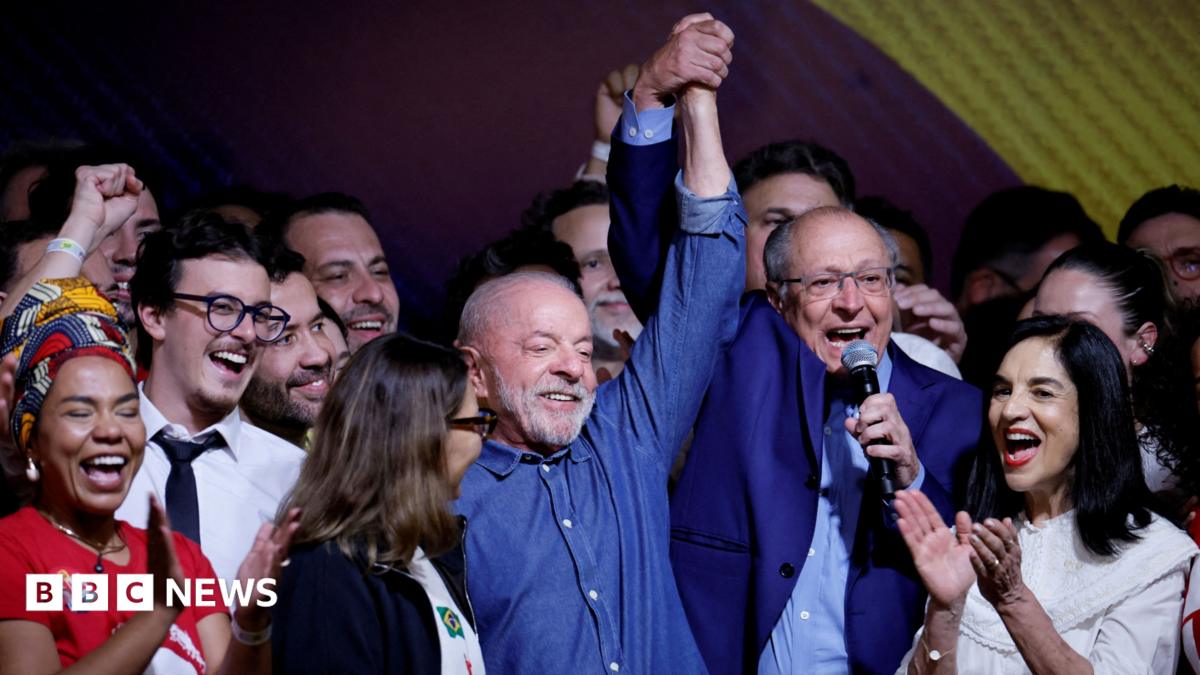
Brazil's President Luiz Inácio Lula da Silva has won a fourth term in office in a dramatic comeback over his right-wing challenger Flávio Bolsonaro. Left-wing leader Lula took 51.79% of votes, becoming the first president since the return of democracy in 1988 to win an election after losing the first round of voting. Lula told celebratory crowds this election is a "loss for negativity, lies", later adding "long live democracy".
Bolsonaro, who is the son of convicted former president Jair Bolsonaro, has so far refused to recognise the result and called for it to be annulled, which experts say is unlikely. In an unprecedented move, polls were also extended for two hours on Sunday evening after both candidates made requests for different reasons. Lula's team had argued that voters in São Paulo and Bahia could not get to the polling stations because of a lack of busses, while Senator Bolsonaro's campaign cited heavy rain in some areas in the south of the country and in São Paulo as the reason for their request.
The decision - issued by the Supreme Court just as polling stations were due to close - meant that some had already shut and were not able to re-open. Supreme Court President Kassio Nunes Marques - appointed by the older Bolsonaro - confirmed Lula's victory and said that the voting extension did not cause issues for the count or the electoral process. Lula secured 51.79% of the vote against Bolsonaro's 48.21% - a difference of 4.4 million votes between the two candidates.
The result came as a surprise after Bolsonaro - who has the backing of his father - won the first round of voting on 4 October with 47% of votes ahead of Lula's 45%. While it is too early to say what pulled Lula to victory, his camp gained momentum ahead of election day, focusing on boosting voter turnout after 33 million people did not vote in round one. Sunday saw the largest drop in abstention between the first and second rounds of a presidential election since 1989.
Lula took to the streets in São Paulo to celebrate and address his supporters. "This, my fourth term, will be the best of any president in the history of this country", the former steelworker said. "It will be the one in which I listen most to the Brazilian people." Vice-President Geraldo Alckmin told him: "You, for the second time, have saved Brazilian democracy." But Bolsonaro - who had been poised to give a victory speech - said the result should be annulled, calling it "inexplicable" and "impossible".
His comments follow that of his father, who is currently serving a 27-year prison sentence after being convicted of a coup attempt after losing the 2022 elections to Lula. But electoral law experts have told BBC Brasil that the chances of the results being annulled are remote. Fernando Neisser from the Institute of Lawyers of São Paulo (Iasp) said it would be "difficult from a legal standpoint" given that the margin of votes was relatively large, and would depend on the "narrative" his lawyers put forward.
Expert Alberto Rollo said that dates for presidential elections in Brazil are fixed and determined by the constitution, which would add another complication to getting it annulled. The incumbent president, who is now 80, has already been president for three non-consecutive terms, serving two terms between January 2003 to December 2010, and again from January 2023. His win makes him the first in Brazilian history to secure a fourth term, which will last until 2030.
But this has been a bitterly fought campaign. The new term - set to start on 5 January - comes amid significant constraints at home and abroad, including animosity from US President Donald Trump. Referring to Trump's ideal - coined the "Donroe Doctrine" - which seeks to establish dominance of the US in the Western Hemisphere, Lula also used his victory speech to stress that Brazil "will not accept being anyone's backyard".
Bolsonaro - much like his father - had US backing, and met Trump at the White House earlier this year to gain support. The 45-year-old's loss keeps Latin America's biggest economy at odds with Washington. Lula has also bucked a wider trend in Latin America, where voters have punished incumbents and welcomed the right, as countries such as Argentina, Chile and Colombia have.
While Trump has yet to react, leaders across the world have commented on Lula's win. "Democracy and multilateralism have won in Brazil", European Commission President Ursula von der Leyen said, as French President Emmanuel Macron said their two nations should work "in service of a more just world". Spanish Prime Minister Pedro Sánchez - also a left-wing leader - called it a "great victory," saying "the comeback of global progressivism has just begun".
Further afield, South African President Cyril Ramaphosa called Lula's victory one for the "global south and progressive forces throughout the world", while Pakistan's President Asif Ali Zardari said he was confident their "longstanding friendly relations" would grow. A little closer to home, Ecuador President Daniel Noboa Azin said the region has "common enemies, shared challenges, and much to gain when we work together." Additional reporting by Vinícius de S. Mendes, BBC Brasil
Source: BBC